A Calgary care plan needs both legal permission to use water and an assessment of what the seeded area actually needs. The regular lawn and landscape schedule includes an establishment exception, but temporary outdoor water restrictions can change the permitted methods or stop watering. Verify the current City information before setting the application date and keep that check active afterward. A printed care sheet should never be treated as authority to ignore a changed restriction.
Know the regular schedule and its scope
Calgary's regular lawn and landscape watering schedule took effect April 29, 2026. The City assigns even street addresses Tuesday, Thursday and Saturday, and odd street addresses Wednesday, Friday and Sunday. The listed windows are midnight to 10 a.m. and 7 p.m. to the end of the day. The City provides additional address rules for buildings and shared irrigation systems.
The source page is the place to verify those details and any later change. Keep the property's applicable street address in the care record; a unit number may not be the correct basis. Do not infer that every available hour should be used. The schedule defines permission, while observed site conditions and the agreed establishment instructions guide whether watering is needed.
Document the new-seed period
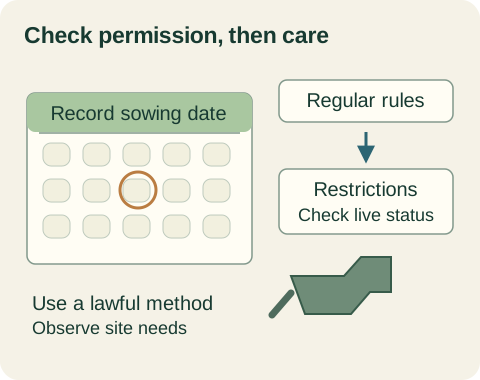
The City's regular schedule permits watering new seed during a 45-day establishment period. Record the sowing date and the treatment boundary so the caregiver knows which area is newly seeded. If work is phased, keep separate dates for the phases. This documentation makes the intended exception clear and prevents a mature area from being casually included in a new-seed plan.
The number of days is an administrative definition for watering permission. It does not mean every seed species will be established by that date, or that a lawn becomes ready for traffic automatically when the period ends. Discuss the transition to ordinary maintenance with the responsible contractor or adviser using growth, rooting, site condition and the applicable project criteria.
Recheck temporary restrictions independently
The City's restrictions page states that temporary restrictions override the regular schedule. At the time of this source review it displayed no active outdoor restrictions; that status can change. Use the live page before treatment and when conditions or municipal announcements change. Do not write a seasonal plan that assumes the status observed while obtaining a quote will remain valid.
For new seed within the City's defined period, the reviewed table permits any watering method in Stages 1 and 2. Stage 3 permits only a hose with the specified automatic-shut-off nozzle or a handheld container; sprinklers and irrigation are not permitted. Stage 4 does not permit this watering. Confirm the live table and obtain City clarification for any uncertain situation.
Resolve the water plan before installation
Ask who supplies the water used during application and who controls establishment watering afterward. Identify the source, access and any permissions that apply. A contractor's application water and the owner's follow-up watering are different responsibilities. If a shared irrigation system is involved, confirm its operator and the applicable address convention rather than relying on a neighbour's interpretation.
Consider what happens if a restriction changes immediately after treatment. The response might involve a permitted method, a revised care arrangement or postponing the application when a workable plan is unavailable. Have the conversation before materials are placed. A project requiring a care action that cannot lawfully or practically be delivered needs an adjusted plan, not an optimistic assumption.
Observe performance instead of prescribing minutes blindly
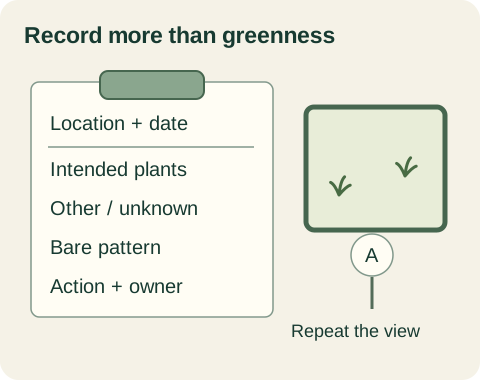
Keep a simple record of weather, observed surface condition, water applied and any runoff. Ask the adviser what signs require an adjustment for the actual seed, soil and treatment. Timer duration alone does not reveal how much water reaches each part of the site. Uneven distribution, obstructions or a low area can make one setting unsuitable across a whole yard.
Do not respond to a dry-looking high spot by automatically increasing watering everywhere. Inspect the wetter areas at the same time, and report runoff or ponding before it becomes a persistent pattern. This guide supplies no universal daily volume or sprinkler runtime. Those values require site information, system output, product guidance and a lawful method appropriate to current conditions.
Make the caregiver's job explicit
Name the person who checks the City status and the person who inspects the lawn. If they are different people, decide how changes are communicated. Leave the sowing dates, treatment sketch, current source links and contractor contact together. Someone covering an absence should know both the equipment controls and the circumstances that require a call instead of continuing the existing schedule.
Create an observation route that does not repeatedly cross vulnerable areas. Include shaded corners, exposed edges and any low pocket rather than viewing only the middle from a window. Ask the adviser how to inspect safely without disrupting the treatment. Photos from fixed points can make a remote conversation clearer, particularly when the caregiver and decision maker cannot visit together.
Plan for the end of the exception
Add a review before the recorded new-seed period ends. Confirm the current regular schedule, any active restriction and the maintenance instructions that will apply next. Separate a municipal permission change from the biological readiness of the lawn. The fact that a watering exception has expired does not settle whether a thin or damaged area needs investigation or whether ordinary use can resume.
If repairs or reseeding are proposed, clarify the new work boundary and the date that applies to it. Do not assume a small repair renews the exception across an entire property. When the interpretation is uncertain, use the City's contact channel for clarification and retain the answer. A site-specific question deserves a site-specific response.
Apply the rule layers to a hypothetical household
Imagine a family treating a yard on an even-addressed property, then leaving for two weeks. Their brief names a caregiver, records the sowing date and places the City's two live pages beside the care instructions. The caregiver is asked to check conditions and current permissions, not simply run the sprinkler for an unchanging number of minutes.
If Stage 3 begins during the absence, the existing automatic program cannot be assumed to remain permitted for new seed. The caregiver contacts the decision maker and uses the current source to review the lawful options. If the available arrangement cannot support the project, that constraint must be addressed openly. A clear contingency plan is more useful than an establishment promise based on uninterrupted water access.
Sources + further reading
- City of Calgary: Lawn and landscape watering schedule
- City of Calgary: Outdoor water restrictions
- City of Calgary: Watering new landscaping
Source review: 2026-10-04. Requirements and programs can change; confirm the current details with the authority or provider.