01 / 8 chapters
Hydroseeding equipment
Choose a complete working system: agitation, usable capacity, pumping, discharge, carrier and the support behind it.
Explore this subject ↗HAUSE / HYDROSEEDERS.CA
FIELD MANUAL 01
The Canadian hydroseeding resource
Equipment, materials, site preparation and establishment. Understand the whole project.
Explore the machines, read the material evidence, prepare the ground and plan the care that follows. Find the chapter that answers your next question.
Explore the library ↗Bring a project to HAUSE →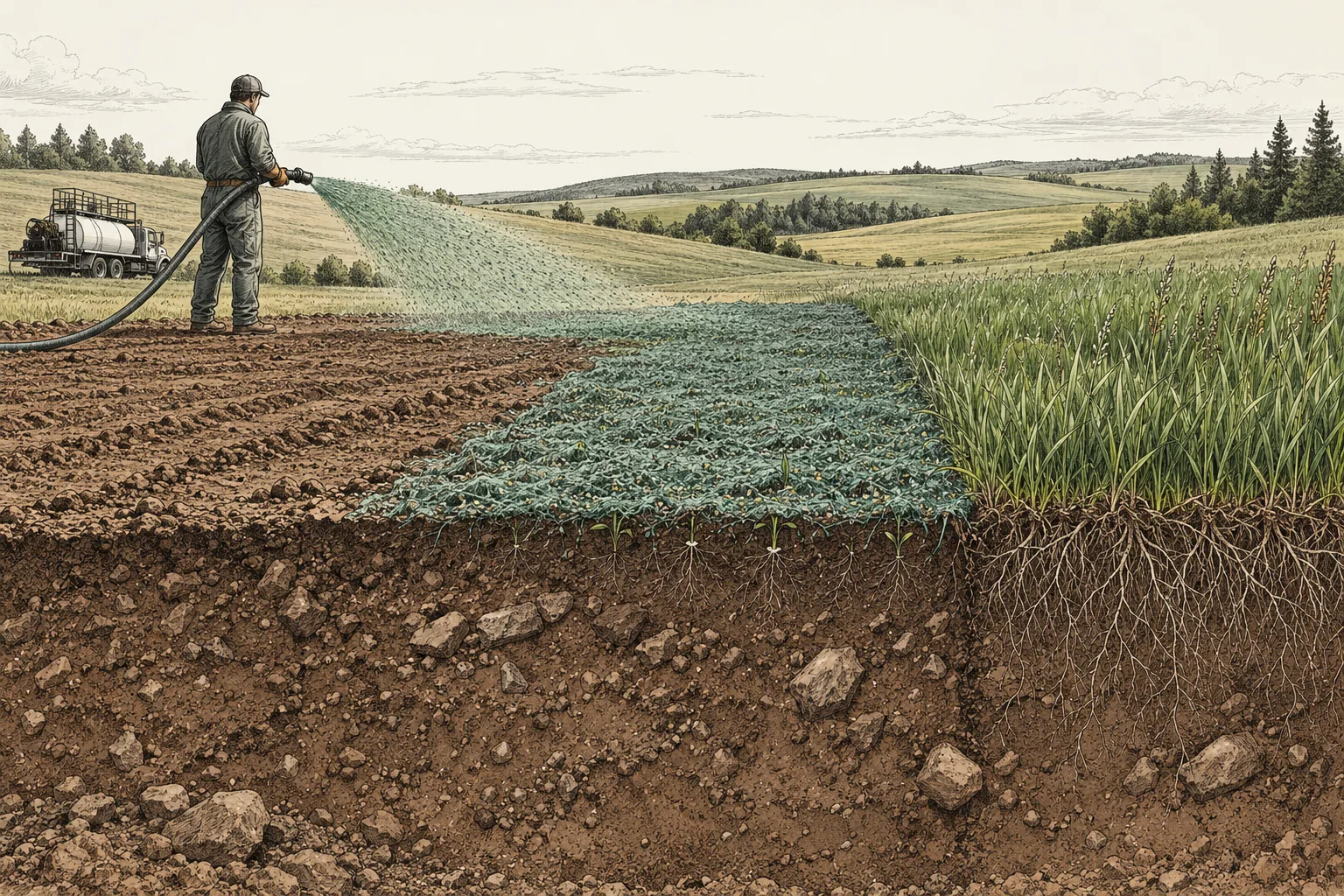
Find your next chapter
01 / 8 chapters
Choose a complete working system: agitation, usable capacity, pumping, discharge, carrier and the support behind it.
Explore this subject ↗02 / 8 chapters
Compare materials by their documented composition, application requirements, compatibility and role in the specified treatment.
Explore this subject ↗03 / 8 chapters
Connect the intended vegetation to seed-lot evidence, the rootzone, the seedbed and the care the ground can receive.
Explore this subject ↗04 / 8 chapters
Organize the job around the specified treatment, the exact equipment, material traceability and a controlled work area.
Explore this subject ↗05 / 8 chapters
Choose the revegetation approach around the land use, risks, site interfaces and establishment resources.
Explore this subject ↗06 / 8 chapters
Turn the handover into a practical care plan that responds to growth stage, weather, soil and the intended vegetation.
Explore this subject ↗07 / 8 chapters
Read the pattern, document the conditions and resolve the cause before choosing a repair.
Explore this subject ↗08 / 8 chapters
Compare the complete project: boundaries, preparation, material evidence, application, care and acceptance.
Explore this subject ↗Start with the unresolved decision
Hydroseeding equipment
5 minute read
Compare agitation through approved materials, loading behaviour, pump configuration, cleanout and the work your crew actually performs.
Read the chapter ↗Mulches, binders and material systems
5 minute read
Compare hydraulic mulch products by specification, composition, equipment compatibility and application requirements instead of colour or category alone.
Read the chapter ↗Seed and soil
5 minute read
Investigate traffic, soil layers, moisture and root restrictions before selecting a compaction treatment for a hydroseeding site.
Read the chapter ↗Establishment and aftercare
5 minute read
Use observed seedbed and seedling development to change care, with separate checks for coverage, runoff and root-zone moisture.
Read the chapter ↗Diagnosing establishment problems
5 minute read
Map weak areas, compare reference locations and test competing explanations before adding seed or changing every care setting.
Read the chapter ↗Scope, quantities and procurement
5 minute read
Normalize area, preparation, materials, care and exclusions before comparing a quoted total or unit price.
Read the chapter ↗Follow the project
Map the footprint, name the vegetation objective and agree who owns preparation and care.
Define the scope →Read the seedbed, review the lot and product evidence, and resolve the remaining readiness questions.
Read the ground →Connect the machine and material instructions to a controlled operation and traceable batch records.
Plan the operation →Adjust care to the actual growth stage and conditions, and investigate concerns before choosing a repair.
Plan establishment →Put numbers on a declared basis
Editable worksheets expose the inputs, formulas and limits. They supply no recommended rates, contractor prices or site approval.
Project quantities
Keep measured rectangles, excluded areas and the total treatment footprint in one record.
Open the worksheet ↗Equipment planning
Estimate full-equivalent batches, reload time and the water provision from your own confirmed planning inputs.
Open the worksheet ↗Establishment planning
Convert an entered depth over a measured area into a volume and a supply-time scenario.
Open the worksheet ↗Seed quantities
Translate a specified pure-live-seed quantity into a bulk quantity using the stated purity and germination basis.
Open the worksheet ↗Procurement
Compare two entered budgets while keeping preparation, application, water, aftercare and tax visible.
Open the worksheet ↗Measurement
Show how entered dimensional uncertainty changes a rectangular plan-area estimate.
Open the worksheet ↗The regional notebooks
Exposure, soils, changing seasons and observations from prairie ground.
Water, access, staging and care zones across a working property.
Light, trees, beds, paths and the everyday life of a city yard.
Measured boundaries, constraints, scope records and a clear handover.
A clearer next step
Tell HAUSE what you are planning, what you have observed and the decision you need help with.
Start a service request ↗